


In a world where every click, call, or visit generates information, companies do not fail due to a lack of data, but because of an inability to turn it into useful context. Most operate with disconnected pieces: spreadsheets that don't speak to each other, isolated support systems, and ERPs storing critical information that remains inaccessible to those who need to make rapid decisions. The result is fragmented growth, teams repeating manual tasks, and AI models that stumble because they only see parts of the puzzle.
Data Studio was created to change that reality. It is not about adding another tool to the stack, but about creating the meeting point between data, teams, and actions within HubSpot. With an intuitive interface—as familiar as a spreadsheet—and powered by Breeze AI, Data Studio turns scattered data into ready-to-activate signals, without friction and without requiring advanced technical skills.
The value lies in the combination: speed, control, and unification. What once required days of exports and corrections now happens in minutes. What was once fragmented across multiple systems is now organized around the customer. And what was once intuition is now measured and executed with precision. Data Studio does not just organize data: it turns chaos into context and context into results.
Data Studio
The problem is not a lack of data; it is a lack of context. In many organizations, information is scattered across ERPs, support systems, spreadsheets, and analytics tools. Each team sees "its" part of the elephant. Data Studio was created to solve this at the root: turning scattered data into actionable inputs within HubSpot, without asking Marketing or Sales to learn SQL or IT to build another temporary bridge.
The promise is not just to "make it possible," but to make it fast. Data Studio offers a spreadsheet-like interface, familiar to most. Yet it is connected to your unified data platform. The practical result: what once required exporting, cleaning, and re-importing is now resolved in minutes with AI assistance, validations, and reusable rules. Centralized management ceases to be an ideal and becomes a routine: a single place to define, transform, and activate.

Key Problems Data Studio Solves
✅ In many companies, the promise of AI stumbles not from a lack of algorithms, but from the absence of complete context. When models work with fragments—clicks without in-person visits, quotes without support history, CRM without DMS—predictions become erratic. Data Studio corrects the problem at the source: it unifies structured and unstructured data into a single semantic fabric that is readable and actionable, and does so with a familiar spreadsheet interface powered by Breeze AI.At Awtana, where we have extensive experience in the real estate sector, for example, traditional lead scoring often looks only at email opens and form submissions; it ignores whether the person already has a bank pre-approval, attended a showroom visit, or showed specific interest in a particular neighborhood. By connecting partner banks, visit scheduling, and WhatsApp conversations with the smart CRM, Breeze suggests normalizations, detects inconsistencies, and elevates these signals to the model.
The result is a score that prioritizes with speed and precision, landing directly in the Sales workspace, where the rep sees the next best action with full unified context just one click away. At an automotive dealership, the story is similar: an after-sales upsell model that doesn't use actual mileage, warranty status, or service workshop notes will rarely recommend the right service at the right time. With Data Studio, the DMS, telemetry (if available), and support tickets are integrated; technical notes become actionable signals; and the service advisor works from an optimized workspace that eliminates tab switching and turns every reminder into a personalized, measurable experience.
✅The second obstacle is not technical; it is human: entire teams trapped in the cycle of exporting, cleaning, importing, week after week. That manual data work is not only expensive and slow; it also destroys centralized management. Data Studio breaks that loop with a pragmatic approach: an easy environment where users apply mapping rules, deduplication, and standardization for dates, currencies, and catalogs, while Breeze AI suggests transformations and validates quality. For example, in a real estate firm with shifting property portfolios, inventory that traveled via Excel yesterday is reflected in the CRM today without friction, with unit layouts, square footage, and price ranges already normalized and ready to segment campaigns by area or price point. The Marketing team no longer has to ask IT for an emergency data export; they operate with speed in a single place and turn updated inventory into audiences, journeys, and reports—all unified.✅The third problem is structural: disconnected systems that fragment the customer profile and force teams to jump from tab to tab. Here, the difference between integrating and unifying is crucial. Integrating moves data; unifying creates context and activates it where business decisions happen. Data Studio, being native to HubSpot, not only brings information in; it organizes it around the customer and delivers it in optimized workspaces for Sales, Service, and Customer Success, where a consistent timeline displays interactions, intent signals, and health metrics.
For example, at a real estate firm with multiple developments, sales reps no longer need to check five different systems to understand a lead: in the workspace, they see the bank pre-approval, viewed properties, recent messages, and availability for a new visit—and from that very spot, they trigger a workflow that sends the right brochure, schedules the tour, and notifies the developer. The personalized experience ceases to be a creative promise and becomes an operational capability powered by unified data, visible directly at the point of action.
Together, these improvements are not just functional; they reorder priorities. AI gains performance because it finally sees the full picture; teams reclaim hours by escaping manual work and reinvest them into strategic activities; and the organization stops operating in data silos to run on centralized management that reinforces decision consistency. The common thread is speed without losing control: data preparation that happens right where campaigns are launched, customers are served, and deals are closed; an easy interface that drives adoption; and a unified framework that prevents loss of context. Data Studio does not add another tool to the stack: it creates the meeting point between data, teams, and actions, turning scattered records into meaningful results with the click efficiency and operational clarity that day-to-day business demands.
Data Quality
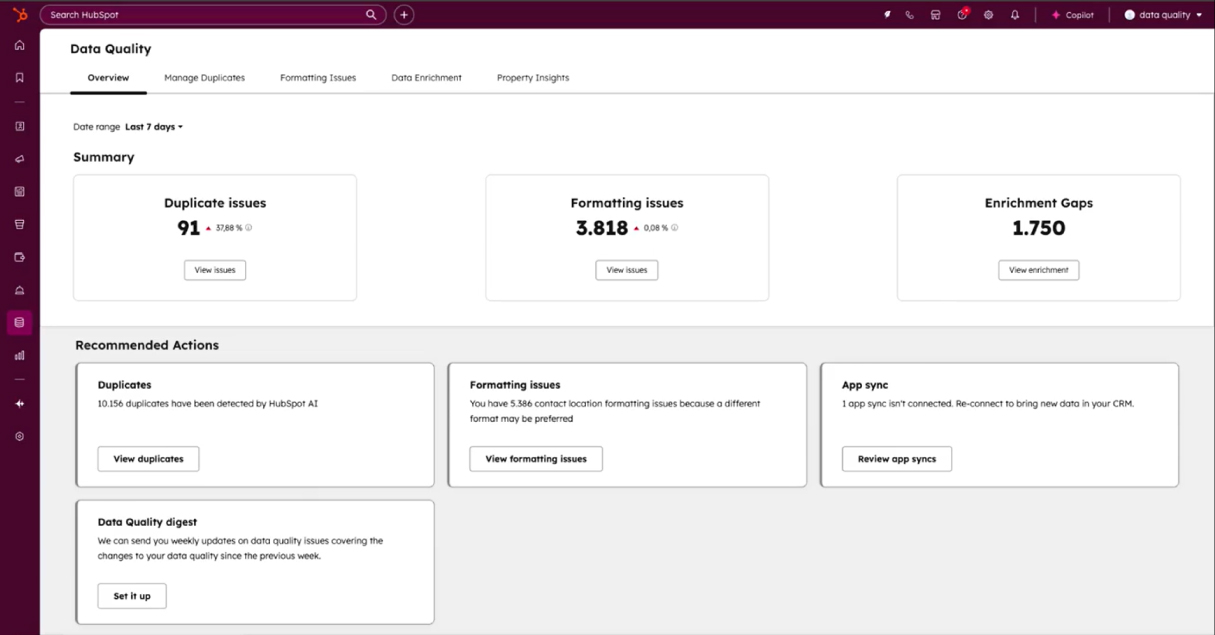
The data quality overview is the radar that keeps your CRM on track. Instead of waiting for errors to emerge, it continuously monitors your databases and automatically fixes the most common issues: it detects duplicates, resolves inconsistent formatting, and flags outdated information before it impacts a campaign, report, or customer interaction. At the same time, it fills in gaps across records by extracting useful details from conversations (emails, notes, chats) and trusted external sources. Everything happens within the same platform, delivering operational speed without sacrificing accuracy.
When data quality is native to HubSpot, the game changes: the platform doesn't just fix issues, it anticipates them. If it detects that two contacts share an email or phone number, it merges them; if a date arrives in an odd format, it normalizes it; if a job title, industry, or country is missing, it suggests enriching it using conversation signals and external catalogs. The team stops putting out fires and reclaims time for strategic initiatives.
Standardized and Centralized Approach
This approach drives centralized management. Validation rules, mappings, and normalization policies live in one place and are consistently applied across the entire database. There is no need to train every department on the same standards or replicate them across multiple tools; they are defined once and inherited by every new record. Furthermore, traceability remains clear: what was changed, when, and why. Data management ceases to be a collection of spreadsheets and becomes unified, auditable, and easy to maintain.
The impact on the customer experience is direct. Accurate, complete data enables personalized messages that arrive at the right time with the right content. When the CRM understands context, history, preferences, and lifecycle stage, teams can build journeys that truly move key metrics: relevant offers, renewal alerts, precise recommendations. Without clean data, AI guesses; with clean data, AI understands and delivers. The difference shows in open, response, conversion, and customer satisfaction rates.
All of this happens on a unified data platform. Unlike point solutions that fragment information, HubSpot brings all customer data together and places it in context for better decision-making. The data quality view is not a separate tool: it feeds the smart CRM, segmentation, reporting, and workflows without friction or delays. This continuity reduces the lag between discovering an issue and triggering a corrective action to just minutes.
A Tool Built for Team Agility and Productivity
Optimized workspaces are the final link that makes this value tangible. Sales, Service, and Customer Success operate in environments where all relevant information appears in one place, without hopping between tabs or losing context. When a rep opens a contact, they already see a cleansed record—free of duplicates, with standardized fields, and filled-in gaps. When they build a report, they trust the metrics because they are comparing apples to apples. When they activate an automation, they know triggers will fire with precision. The experience is easy, and execution is fast.
In short, data quality in HubSpot shifts the paradigm from cleaning up to preventing issues. With continuous monitoring, automated corrections, and intelligent enrichment, it frees teams from mechanical tasks and returns control to a centralized hub. The result is a unified operation that scales smoothly, enables personalized experiences that drive results, and maintains the speed business requires—all within workspaces designed to decide and act in one place.
Marketing Hub: Segments
Formerly known as lists, Segments now features a dedicated application that lets you discover audiences with AI, filter using intuitive logic, and activate results in a single step—all connected to unified CRM data. The primary focus is speed: finding, creating, and activating segments stops being a slow, fragmented task and becomes an easy, unified workflow, without switching between tools.
Inside Segments, AI works for you from minute one. With the AI Segment Builder, you describe what you're looking for in natural language—contacts who opened the last newsletter, visited the pricing page, and have a recent MQL status—and the system builds the segment, suggests criteria you might have missed, and readies it for use. The Segments Home section gives you an immediate view of what matters: recent segments, performance, and AI recommendations that identify behavioral patterns and propose audiences with a high propensity to convert. When surgical precision is needed, the Advanced Logic Builder allows you to combine time-based conditions, exclusions, and cross-object relationships (contacts, companies, deals) without sacrificing simplicity. Everything runs within the same environment, reducing operational friction and maintaining centralized management over rules and definitions.
Tailored, Real-Time Personalization
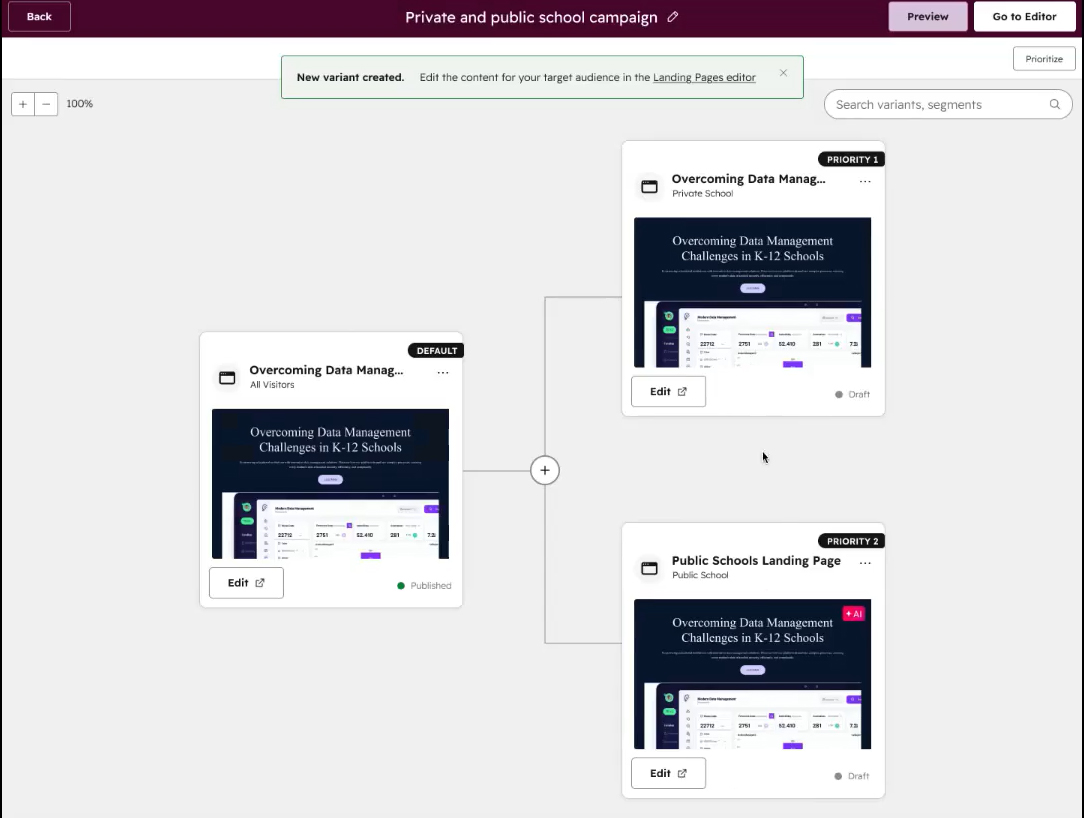
The real value emerges when these segments connect with personalization. Personalization tools bring all tailoring capabilities together in one place so you can build personalized web experiences and measure their impact without leaving HubSpot. The Personalization Home serves as your mission control: from there, you manage experiences, review results, and decide the next move. The Personalization Agent removes guesswork: it automatically identifies which segments respond best to specific messaging and instantly generates website variants and CTAs tailored to those audiences. In practice, you go from asking "who should we personalize for?" to having both the audience and the variation ready in just a few clicks. That is speed with control.
To scale smoothly, content personalization variants transform the way teams work. Instead of editing module by module, you can create multiple versions of a landing page or CTA from a single interface. You can maintain one variant for existing customers, another for cold leads, and another for target accounts—all powered by smart segments. Because everything lives in the same unified data platform, performance is measured consistently, and decisions are backed by complete context rather than disjointed pieces.
This consistency doesn't just benefit Marketing. In optimized workspaces for Sales, Service, and Customer Success, segments and their outcomes appear right where teams take action: sales reps see which segment an account belongs to and trigger the appropriate playbook; service teams identify at-risk customers and prioritize tickets; customer success detects expansion opportunities. There is no need to open ten tabs or piece together context: relevant information is unified, ready to decide and act with speed.
Taken together, Segments turns targeting and personalization into a rapid cycle: discover with AI, segment with precision, personalize in minutes, measure, and iterate. You maintain centralized management over definitions and rules, operate on a unified data platform that delivers better decision-making, and work in workspaces where everything is at your fingertips. The result is customer-centric, personalized experiences that drive meaningful results without sacrificing the fundamentals: speed, simplicity, and unification.
Marketing Hub: Marketing Studio
Marketing Studio: an AI-powered collaborative canvas within HubSpot that gives you speed while remaining easy and unified. Instead of jumping between Figma, Asana, Slack, and countless browser tabs, you work in a single space that brings together the brief, assets, calendar, approvals, and multichannel launch. The difference is clear from minute one: less friction, sharper focus, and decisions powered by the complete context of a unified data platform.
How does it work in practice? You start with a campaign brief: objective, audience, offer, and timeline. AI turns it into a visual plan with suggested channels, a proposed schedule, initial copy and baseline designs, and a measurement structure aligned with your KPIs. Because everything lives inside HubSpot, the canvas draws directly from the smart CRM: your segments and properties (industry, deal stage, deal value, behavior) connect to the campaign without additional setup. From that same space, you can review drafts, collaborate in real time with your team, assign tasks, and, once finalized, orchestrate the launch across email, web, ads, social, and automations—without switching tools or losing momentum.

The Dream Tool for Marketing Teams
This approach addresses fragmented planning at its core. Previously, teams wasted hours coordinating across multiple tools and reconstructing the campaign status in every discussion. Now, the canvas gives you a centralized view: strategy, assets, and timelines coexist on a single board, updated for everyone in real time. Centralized management also streamlines permissions, version history, and approvals: who changed what and when is fully tracked, turning messy email chains into a transparent project workflow.
It also eliminates the hurdle of manual campaign creation. Where building campaigns "from scratch" once took days, AI now proposes the channel mix, generates content drafts, suggests audiences, and maps key milestones on the calendar. It is not an autopilot; it is a copilot that handles the initial 80% so your team can focus on what moves the needle: strategic angles, messaging nuance, and optimization. Because you work on unified data, recommendations do not stem from a black box: they are grounded in the actual behavior of your contacts and accounts, maximizing the relevance of every send and variation.
Collaboration and Synergy: The Entire Team on a Single Visual Canvas
Siloed collaboration becomes a thing of the past. The entire team works on the same visual canvas, commenting in context, editing, and approving without interrupting workflow. If Sales needs to see what messaging target accounts will receive, they find it directly in their optimized workspace; if Service needs to coordinate a proactive notification, they can do so without piecing together the customer's history. It eliminates tab juggling and, with it, the loss of context. The outcome: fewer back-and-forths, along with campaigns that launch quickly and in full alignment.
Consider two straightforward examples. In real estate, you want to drive momentum during the final presale phase. You upload a brief detailing available inventory, target neighborhoods, and buyer profiles. AI proposes the cadence: nurture emails for warm leads, dynamic ads based on floor plans, and personalized CTAs on the landing page. Because the CRM already knows who visited the showroom, who holds a bank pre-approval, and which areas were marked as favorites, the content adapts seamlessly: every segment receives the right message. The team reviews and refines directly on the canvas, approves, and launches with one click. In the automotive space, imagine launching a test-drive campaign for a new vehicle model. Marketing Studio suggests audiences based on vehicle history, warranty status, and content affinity; drafts emails, ad creatives, and landing pages; and schedules bookings according to dealership capacity. Sales sees the entire context in their workspace, follows up using a unified playbook, and manages outreach entirely within HubSpot. In both cases, value stems from speed backed by centralized management, yielding personalized experiences that directly accelerate conversions and pipeline.
Conclusion
When teams work with unified data and collaborative tools in a single place, speed stops being a promise and becomes the default way of working. Data Hub ensures information arrives clean, complete, and with centralized management; Marketing Hub turns that context into personalized experiences that increase open rates, clicks, appointments, and sales. Optimized workspaces keep everyone aligned—Marketing, Sales, and Service—eliminating delays caused by a lack of visibility. This is the real game changer: moving away from improvised campaigns toward an easy, unified operation that scales without friction, learns with every iteration, and turns scattered data into meaningful results. With HubSpot, the path from data to action is shorter, clearer, and far more profitable.

